
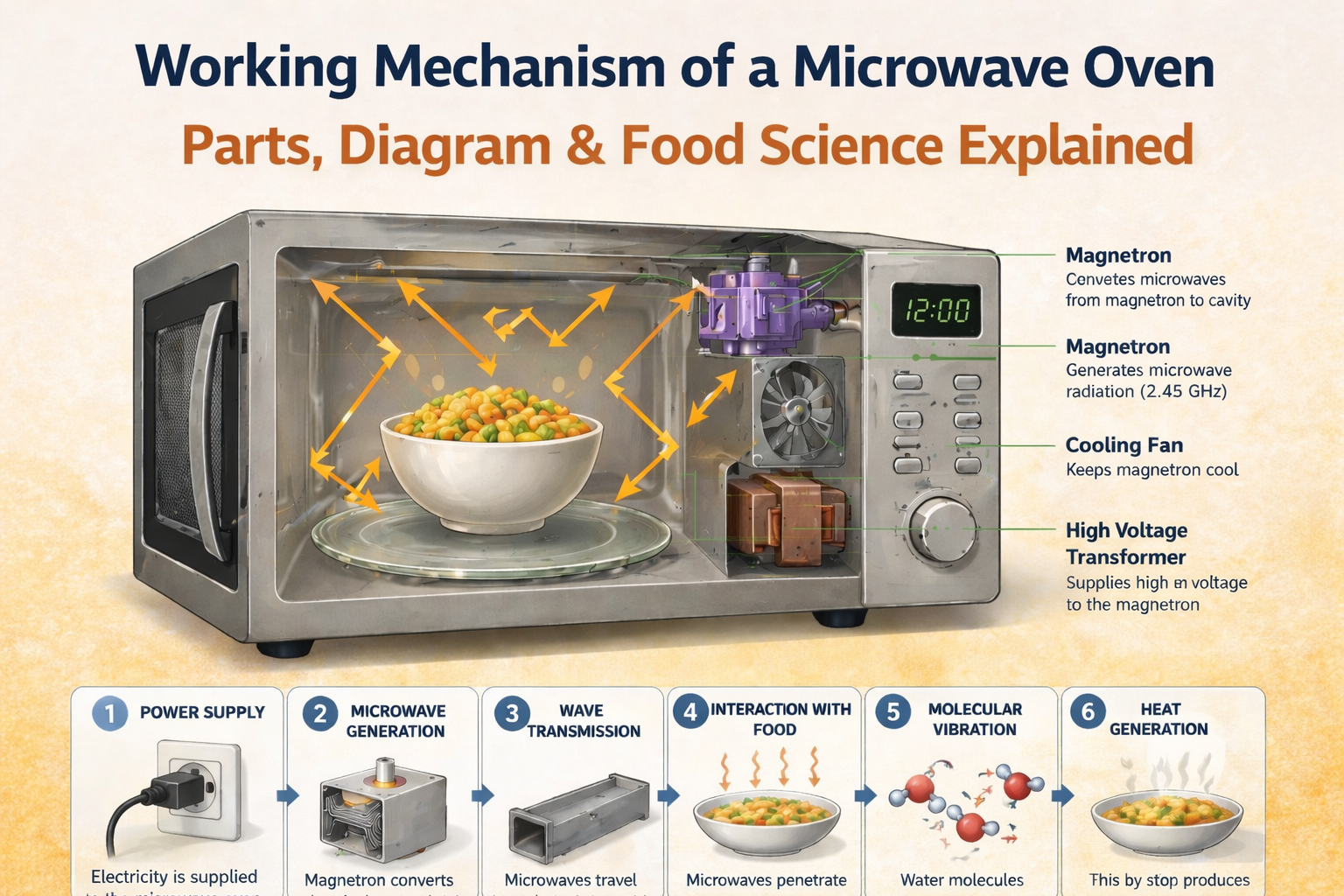
Introduction
From my experience in the food industry, I’ve seen how even simple equipment like a microwave plays a crucial role—not just in homes, but also in labs and production environments.
We use it every day, often without thinking twice.
But once you understand what’s happening inside, you start looking at it very differently.
What is a Microwave Oven?
A microwave oven is a kitchen appliance that uses electromagnetic waves (microwaves) to heat food.
Unlike conventional cooking:
- There is no direct flame
- Heat is not transferred from outside surfaces
- Instead, heat is generated within the food itself
This is what makes microwave heating fast and efficient.
Main Parts of a Microwave Oven
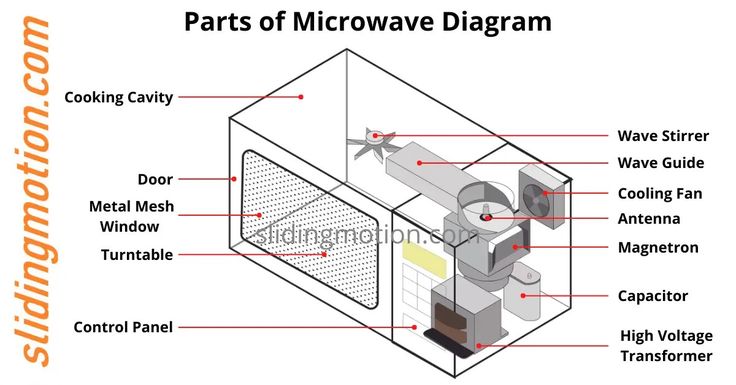
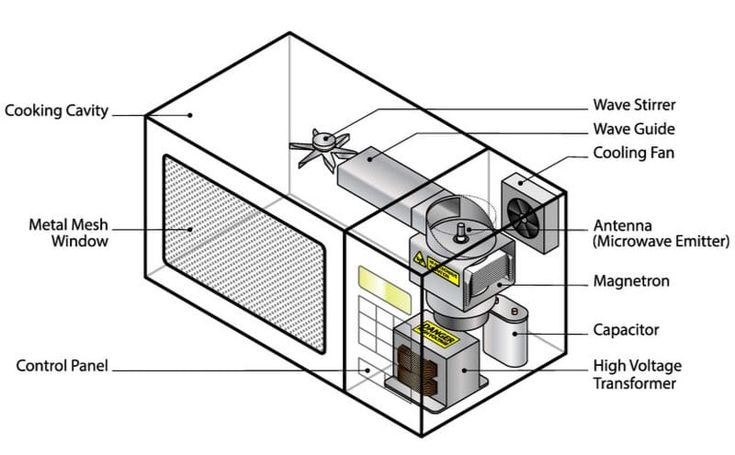
1. Magnetron
The magnetron is the core component of a microwave oven.
It converts electrical energy into microwave radiation.
Without this component, the microwave cannot function.
2. Waveguide
The waveguide directs microwaves from the magnetron into the cooking chamber.
It ensures energy flows efficiently toward the food.
3. Microwave Cavity
This is the internal metal chamber where food is placed.
The metal walls reflect microwaves, allowing them to bounce and interact with the food.
4. Turntable
The turntable rotates food during heating.
This helps reduce uneven heating and improves temperature distribution.
5. High Voltage Transformer
This component supplies the high voltage required to operate the magnetron.
6. Control Panel
The control panel allows the user to set time, power level, and cooking modes.
7. Door and Safety System
The door has safety interlocks that stop the microwave from operating when opened.
This prevents exposure to microwave radiation.
Working Mechanism of a Microwave Oven
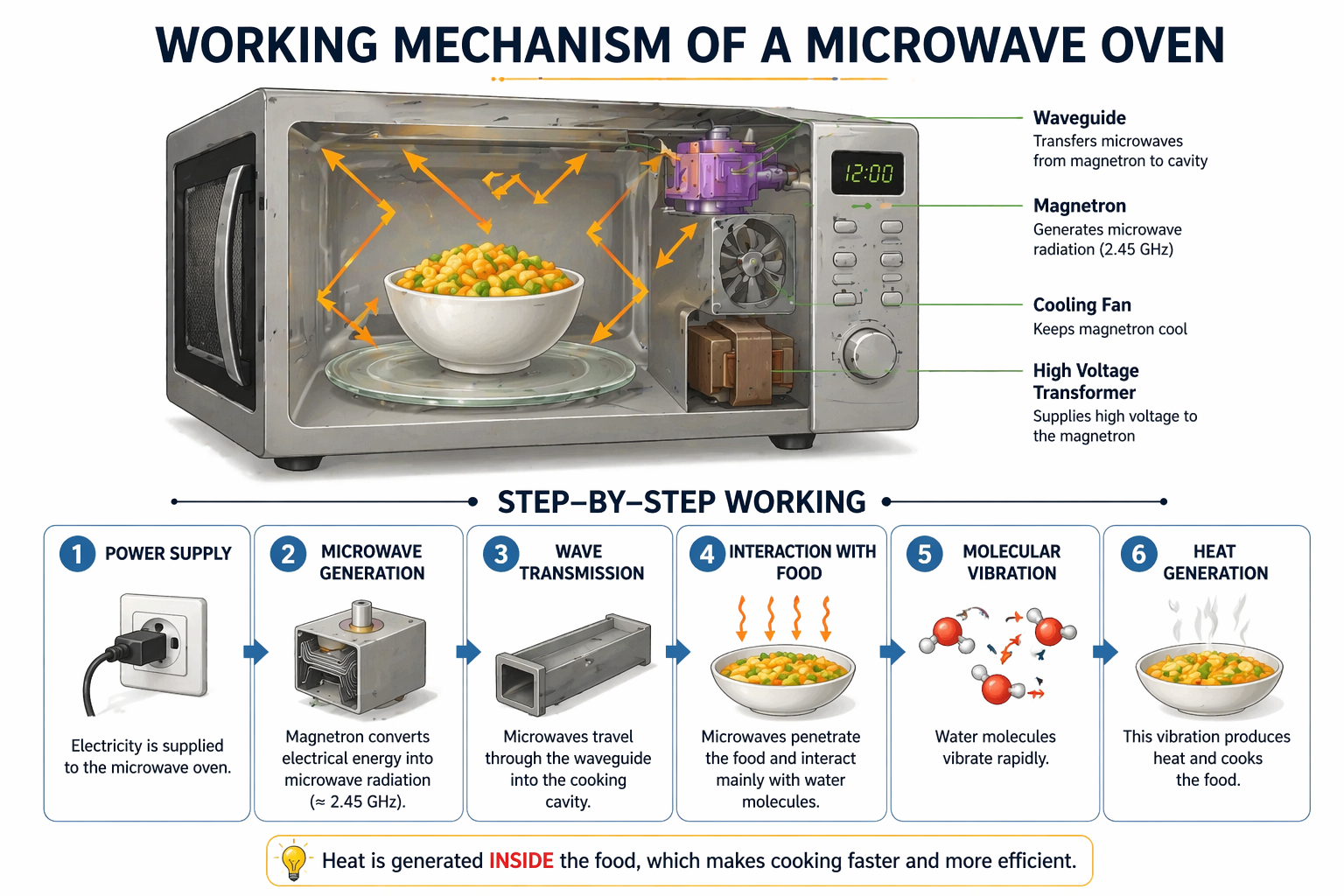
The working of a microwave oven can be understood step by step:
Step 1: Power Input
Electricity is supplied to the system.
Step 2: Microwave Generation
The magnetron generates microwaves, typically at a frequency of 2.45 GHz.
Step 3: Wave Transmission
These waves travel through the waveguide into the cooking chamber.
Step 4: Interaction with Food
Microwaves interact mainly with water molecules present in food.
Step 5: Molecular Movement
Water molecules begin to vibrate rapidly.
Step 6: Heat Generation
This vibration produces heat, which cooks the food.
Food Science Behind Microwave Heating
Microwave heating depends largely on the composition of food.
- Foods with higher water content heat faster
- Foods with lower moisture heat more slowly
- Mixed foods may heat unevenly
This is why something like curry heats quickly, while bread may remain relatively cool.
Why Metal Should Not Be Used
Metal surfaces reflect microwaves instead of absorbing them.
This can lead to sparking (arcing) and may damage the appliance.
In simple terms, the energy is not absorbed by the food and instead builds up inside the cavity.
Practical Observations from Experience
In practical usage, small changes can make a noticeable difference:
- Stirring improves heat distribution
- Covering food helps retain moisture
- Using appropriate containers ensures safe and efficient heating
These are simple steps, but they significantly improve results.
Exam Questions and Answers
Q1. What is the principle of microwave heating?
Microwave heating is based on dielectric heating, where electromagnetic waves cause polar molecules (mainly water) to vibrate and generate heat.
Q2. What is the function of a magnetron?
It converts electrical energy into microwave radiation.
Q3. Why does uneven heating occur in microwaves?
Due to uneven distribution of waves and differences in food composition.
Q4. Why should metal not be used in microwave ovens?
Because it reflects microwaves, leading to sparking and potential damage.
Q5. What is the role of the turntable?
It rotates food to ensure more uniform heating.
Q6. Which molecules are primarily responsible for microwave heating?
Water molecules.
Q7. What is dielectric heating?
Heating caused by the vibration of polar molecules under electromagnetic waves.
Conclusion
In my experience, a microwave is often underestimated.
It is not just a convenience appliance—it is a well-designed system based on physics, food chemistry, and engineering.
Understanding how it works not only improves daily use but also strengthens fundamental knowledge for anyone in food science and technology.
For equipment check this 👉https://amzn.to/3OLALE2