
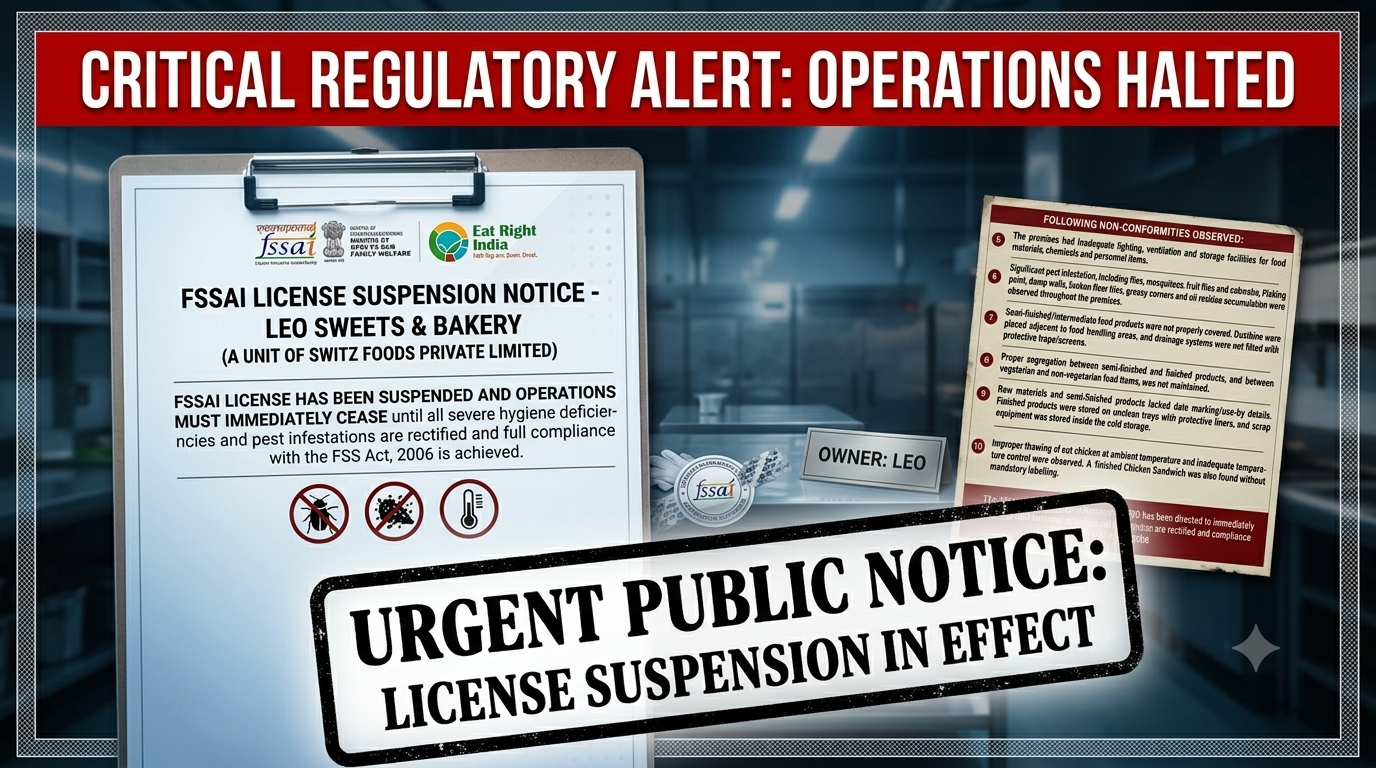
In a major enforcement action, the Food Safety and Standards Authority of India (FSSAI) has officially suspended the food business license of Kolkata-headquartered Switz Foods Private Limited. The decision comes following a comprehensive inspection of the company’s food manufacturing unit, which uncovered multiple critical non-conformities, severe hygiene breaches, and public safety risks.
The food regulator has issued a direct mandate ordering the company to immediately cease all food business activities until every deficiency is rectified and verified to comply with the rules outlined in the Food Safety and Standards (FSS) Act, 2006.
🔍 Key Findings: 10 Non-Conformities Cited by FSSAI
During the regulatory audit, food safety inspectors documented widespread non-compliance across processing, equipment maintenance, food handling, and storage areas:
1. Unhygienic Manufacturing & Storage Conditions
Food products were actively being processed, packaged, and stored in highly unhygienic environments, posing an immediate risk of contamination and threat to consumer safety.
2. Inadequate Sanitation Across High-Risk Areas
General sanitation standards were marked as unsatisfactory. High-risk zones—including the crate-washing area, non-vegetarian food reception, and the washing zone around the carrot-cutting machine—failed cleanliness protocols.
3. Neglected Equipment Maintenance & Water Leakage
Essential machinery, HDPE crates, storage trays, trolleys, molds, and heated kettles lacked proper cleaning. Inspectors also reported water leaking directly from air conditioning pipelines over active product storage zones.
4. Corrosion & Lack of Pest Screening
Exhaust fans were not fitted with insect-proof screens. Visible rust and corrosion were detected on food processing machinery, ventilation setups, and utensils used in direct contact with food.
5. Inadequate Infrastructure & Storage Facilities
The facility lacked basic operational standards, including adequate lighting, proper ventilation, and separate storage spaces for raw food ingredients, industrial chemicals, and personal belongings.
6. Active Pest Infestation & Structural Decay
Inspectors noted significant pest activity—including flies, fruit flies, mosquitoes, and widespread cobwebs. Structural hazards included flaking paint, damp walls, cracked/broken floor tiles, and heavy oil/grease build-up in corners.
7. Exposed Food Products & Uncovered Drains
Semi-finished and intermediate products were stored uncovered. Dustbins near food prep zones lacked proper covers, and drainage channels lacked protective traps or screens.
8. Failure in Veg and Non-Veg Segregation
The plant failed to enforce physical segregation between semi-finished and finished goods, as well as between vegetarian and non-vegetarian food items, raising cross-contamination concerns.
9. Missing Expiry Labels & Scrap Equipment in Cold Storage
Raw ingredients and semi-finished stocks lacked mandatory date markings and use-by details. Finished bakery products rested on unclean trays without liners, while scrap/disused equipment was stored inside cold rooms.
10. Temperature Violations & Unlabeled Products
Cut chicken was found thawing at ambient room temperature rather than under controlled, food-safe cold conditions. Additionally, packaged Chicken Sandwiches were identified and seized without required regulatory labeling.
🏢 About Switz Foods Private Limited
Established in 1991, Kolkata-based Switz Foods Private Limited is a major player in eastern India’s bakery market, manufacturing items like breads, cakes, cookies, and packaged snacks. It forms part of the international Switz Group, a Dubai-headquartered conglomerate with operations spanning multiple countries.
⚡ What Happens Next?
The regulatory directive is unambiguous: Switz Foods cannot manufacture, distribute, or sell food products until complete operational compliance is restored.
To regain its license, Switz Foods must:
1. Conduct extensive facility repairs, structural renovations, and pest eradication.
2. Overhaul sanitization workflows and upgrade equipment maintenance schedules.
3. Implement strict traceability, labeling, and cross-contamination protocols.
4. Undergo a rigorous re-inspection by FSSAI officials prior to license reinstatement.
📌 Frequently Asked Questions (FAQs)
Q: Why was Switz Foods’ license suspended by FSSAI?
A: FSSAI suspended the license due to serious hygiene non-compliances, including pest infestations, unhygienic equipment, cross-contamination risks between vegetarian and non-vegetarian food, and improper temperature controls.
Q: Can Switz Foods continue selling its products during the suspension?
A: No. FSSAI has ordered Switz Foods to immediately halt all food production and business operations until full compliance with the FSS Act, 2006 is achieved.
Q: What regulatory act governs this enforcement?
A: The enforcement is conducted under the rules and mandates of the Food Safety and Standards (FSS) Act, 2006.