
I still remember that simple moment—sitting with a warm toast and slowly spreading a spoonful of golden honey.
It tasted different. Smoother, richer, almost alive.
That’s when a question came to mind:
What actually makes honey so special?
What I discovered was not just a natural sweetener, but a complete biochemical process happening inside a beehive.
More Than Just a Sweetener
Honey is not just sugar.
It is a complex mixture of glucose, fructose, enzymes, organic acids, and bioactive compounds. Every drop is carefully processed by bees through a natural system that food scientists still admire.
In technical terms, honey is known as a natural high-invert sugar.
What is Invert Sugar
Invert sugar is formed when sucrose breaks down into two simpler sugars: glucose and fructose.
This process is called inversion.
Unlike industrial processes where acids or enzymes are added externally, bees perform this transformation naturally.
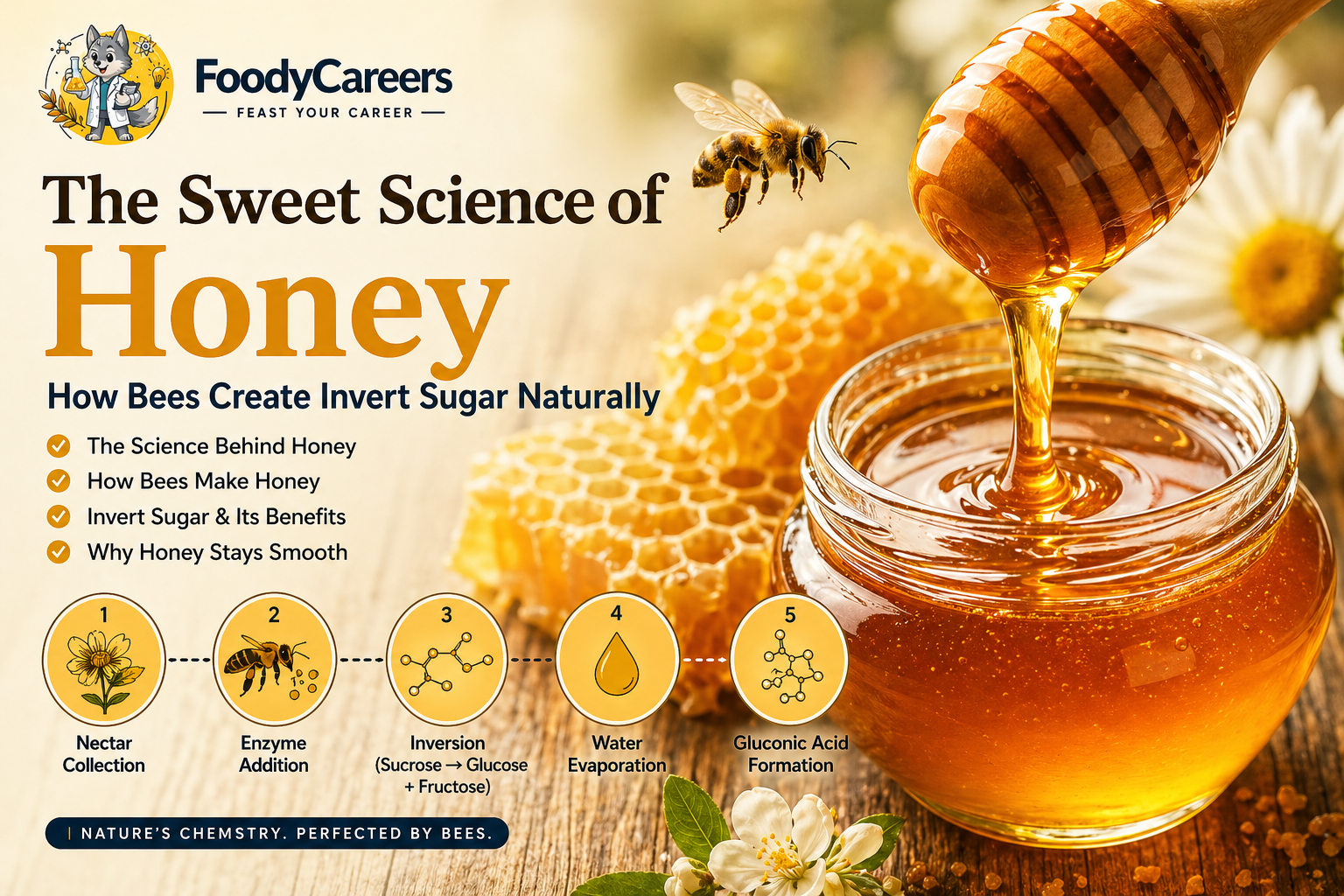
How Bees Make Honey: Step-by-Step Process
1. Nectar Collection
Bees collect nectar from flowers. This nectar mainly contains sucrose along with small amounts of glucose and fructose.
2. Enzyme Addition
Inside the bee’s body, nectar mixes with enzymes secreted from hypopharyngeal glands. The key enzymes involved are invertase and glucose oxidase.
3. Inversion Process
Invertase breaks down sucrose into glucose and fructose. This is the stage where nectar starts turning into a natural invert sugar system.
4. Water Evaporation
Bees deposit nectar into honeycombs and continuously fan it with their wings. This reduces moisture content significantly, making honey thick and stable.
5. Formation of Gluconic Acid
Glucose oxidase converts glucose into gluconic acid and hydrogen peroxide. This step gives honey its mild acidity and natural antimicrobial properties.
Where Do These Components Come From
The invert sugar in honey comes from the breakdown of sucrose present in nectar.
Gluconic acid is produced through enzyme activity on glucose.
All enzymes involved in this process are secreted by the bees themselves.
Why Honey Has a Smooth Texture
One of the most interesting properties of honey is its smooth, non-grainy texture.
In regular sugar solutions, sucrose tends to crystallize, which leads to a rough or grainy texture.
In honey, the presence of glucose and fructose disrupts this crystallization process.
This is why honey is widely used in confectionery and bakery products to maintain smoothness and consistency.
Why Honey Acts as a Natural Preservative
Honey has natural preservation properties due to:
Low water activity
Mild acidity from gluconic acid
Presence of hydrogen peroxide
These factors prevent the growth of microorganisms, making honey shelf-stable for long periods.
A Spoonful of Science
That spoon of honey on your toast is more than just sweetness.
It represents enzymatic reactions, controlled moisture reduction, and natural sugar transformation. All of this happens without any industrial intervention.
Final Thought
The next time you use honey in your tea or recipes, remember that you are adding more than flavor.
You are adding a naturally engineered system of sugars created through one of nature’s most efficient processes.